
5. Mahajanapadas
Free Ancient India rapid revision notes for UPSC, APPSC and TGPSC. Original notes are presented below with their tables, images and visual aids preserved.
5. Mahajanapadas
5.1 Background
In the Later Vedic period tribes settled on land and became janapadas (territories). In the 6th century BCE larger and stronger janapadas grew by conquering their neighbours and were called Mahajanapadas ("great realms").
This was the period of the Second Urbanisation (the first was the Harappan). Iron tools, rice farming, trade and punch-marked coins supported towns and kingdoms in the middle Ganga plain.
Archaeologically the period is linked with Northern Black Polished Ware (NBPW), which marks the growth of cities.
Sources
Source |
Information |
Anguttara Nikaya (Buddhist) |
Lists sixteen Mahajanapadas; the list most used in textbooks |
Mahavastu (Buddhist) |
A similar list of the sixteen |
Bhagavati Sutra (Jain) |
Also gives a list of sixteen, with some different names (such as Vanga and Malaya) |
Panini's Ashtadhyayi |
Mentions many janapadas of the north-west |
5.2 The Sixteen Mahajanapadas
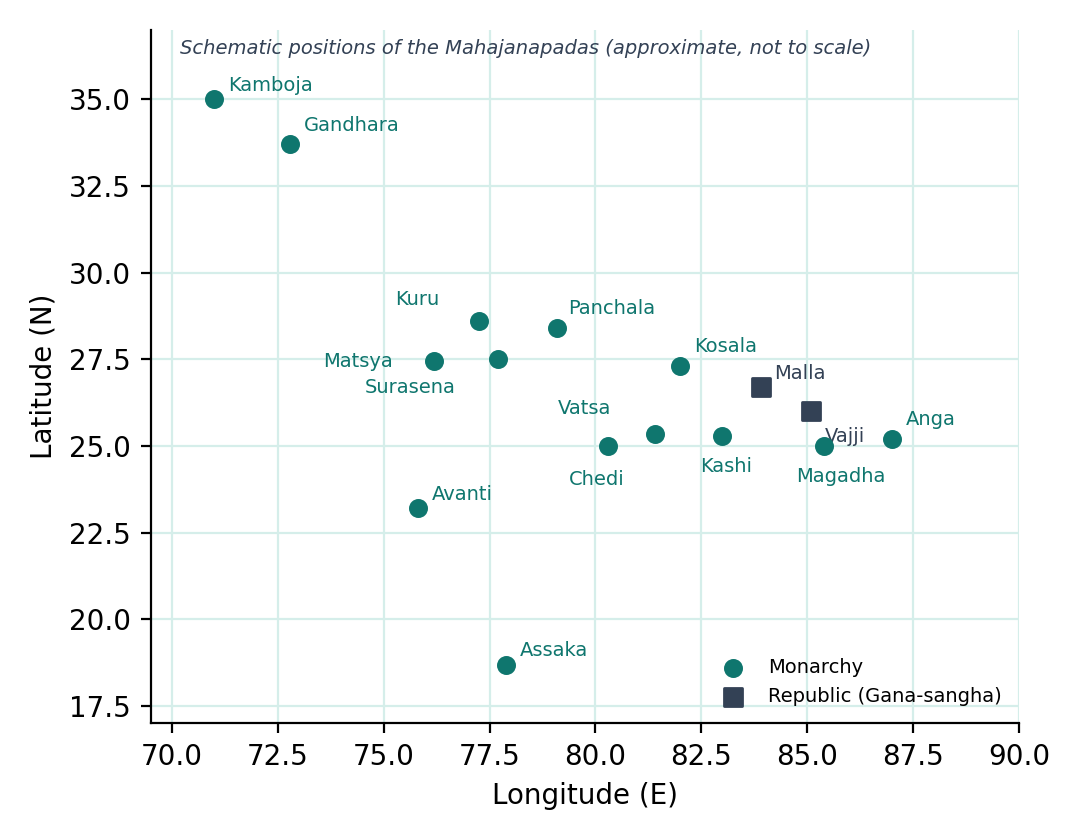
Maha-janapada |
Capital |
Region |
Key Points |
Anga |
Champa |
Bhagalpur and Munger (Bihar) |
Conquered by Bimbisara of Magadha; Champa was a trade centre |
Maga-dha |
Rajagriha (Girivraja); later Pataliputra |
South Bihar |
Became the most powerful; Rajagriha had hills for defence and nearby iron |
Kashi |
Varanasi |
Varanasi region |
Famed for cloth and learning; absorbed by Kosala |
Kosala |
Shravasti (north); Saketa/ Ayodhya (south) |
Eastern Uttar Pradesh |
King Prasenajit; Buddha spent many rainy seasons at Shravasti |
Vajji |
Vaishali |
North Bihar |
A confederation of eight clans, including the Licchavis; a republic |
Malla |
Kushinara and Pava |
Gorakhpur region |
A republic; the Buddha died at Kushinara |
Chedi |
Shuktimati |
Bundelkhand |
Linked with the Shishupala of the Mahabharata |
Vatsa |
Kaushambi |
Near Prayagraj |
King Udayana; a rich trade centre on the Yamuna |
Kuru |
Indraprastha |
Delhi-Meerut region |
Once powerful (Mahabharata) but weak by the Buddha's time |
Pan-chala |
Ahichchhatra (north); Kampilya (south) |
Rohilkhand |
Kanyakubja (Kannauj) was a part |
Matsya |
Viratanagara |
Jaipur-Alwar region |
A small kingdom of little importance by then |
Sura-sena |
Mathura |
Around Mathura |
Home of Krishna in tradition; early supporters of Buddhism |
Assaka (Ash-maka) |
Potali / Potana |
Banks of the Godavari |
Only Mahajanapada in South India |
Avanti |
Ujjain (north); Mahishmati (south) |
Malwa |
King Chanda Pradyota; strong because of iron mines; later taken by Shishunaga |
Gan-dhara |
Taxila |
Peshawar and Rawalpindi region |
Trade and learning centre (Taxila); Pukkusati was its ruler in Bimbisara's time |
Kam-boja |
Rajapura |
North-west (Hindu Kush region) |
Famous for horses |
Remember
|
5.3 Monarchies and Republics
Feature |
Monarchies |
Republics (Gana-sanghas) |
Head |
Hereditary king (Raja) |
Elected chief (often called Raja or Ganapramukha); some had a council of such chiefs |
Assembly |
Royal court and advisers |
Assembly of clan leaders in a Santhagara (hall); decisions after debate and vote |
Examples |
Magadha, Kosala, Vatsa, Avanti |
Vajji (Licchavi), Malla, Shakya, Koliya |
Fate |
Grew into empires |
Mostly conquered by Magadha; Ajatashatru defeated the Vajjis |
Other republics outside the sixteen
Republic |
Capital / Area |
Notes |
Shakyas |
Kapilavastu |
Home of the Buddha; Lumbini was in their land |
Koliyas |
Ramagrama |
Neighbours of the Shakyas; the Buddha's mother belonged to this clan |
Bhaggas |
Sumsumara-giri |
Near Vatsa |
Bulis |
Allakappa |
Held a share of the Buddha's relics |
Kalamas |
Kesaputta |
Where the Buddha taught the Kalama Sutta |
Moriyas |
Pipphalivana |
Linked with the ancestors of the Mauryas in Buddhist tradition |
Videhas |
Mithila |
Part of the Vajji confederation; King Janaka in the Later Vedic age |
5.4 Polity, Economy and Society
Kings kept standing armies and officials and collected regular taxes: bali (tribute), bhaga (a share of produce, about one-sixth) and tolls.
Fortified capitals were built; wealth from trade and agriculture strengthened the kings.
Trade routes: the Uttarapatha (north-west to Pataliputra and the east) and the Dakshinapatha (towards the Deccan).
Guilds (shrenis) of artisans and merchants grew; rich merchants were called Shresthis and Gahapatis (householders).
New cities: Rajagriha, Shravasti, Champa, Kaushambi, Ujjain, Varanasi, Vaishali and Taxila.
The monarchies favoured Brahmanical rule, while the republics gave more support to Buddhism and Jainism; both Mahavira and the Buddha were born in republican clans.
Quick Recall
|
Explore structured courses and guidance for your target examination.