
7. Mauryan Era
Free Ancient India rapid revision notes for UPSC, APPSC and TGPSC. Original notes are presented below with their tables, images and visual aids preserved.
7. Mauryan Era
7.1 Sources
Source |
Information |
Arthashastra (Kautilya) |
Treatise on statecraft, administration, economy and war; found by R. Shamasastry in 1904 at Mysore. Parts were written later than the Mauryan age |
Indica (Megasthenes) |
Greek ambassador of Seleucus Nicator; survives only in quotations; describes Pataliputra and Mauryan society |
Mudrarakshasa |
Play by Vishakhadatta on Chandragupta and Chanakya |
Buddhist and Jain texts |
Dipavamsa, Mahavamsa, Divyavadana (Ashoka); Jain account of Chandragupta's last years |
Ashokan inscriptions |
The most reliable source for Ashoka and his Dhamma |
Junagadh inscription of Rudradaman |
Mentions Pushyagupta (Chandragupta's governor), who built the Sudarshana lake, and Ashoka's governor Tushaspa |
Archaeology |
Kumrahar (80-pillared hall) and Bulandibagh at Pataliputra; NBPW pottery; punch-marked coins |
7.2 Chandragupta Maurya (about 321 to 297 BCE)
Origin: Buddhist texts link him with the Moriya clan of Pipphalivana; some texts call him of low birth. His adviser was Chanakya (Kautilya or Vishnugupta).
About 321 BCE he overthrew Dhana Nanda and took Pataliputra.
He conquered the north-west after Alexander left. In 305 BCE he defeated Seleucus Nicator, who gave up Aria (Herat), Arachosia (Kandahar), Gedrosia (Baluchistan) and Paropamisadae (Kabul). In return, Chandragupta gave 500 elephants; a marriage alliance and the posting of Megasthenes followed.
His empire stretched from the Hindu Kush to Bengal and from Kashmir to Saurashtra (Junagadh inscription); he probably also held parts of the Deccan.
Jain tradition says he became a Jain monk under Bhadrabahu, moved south to Shravanabelagola and died by sallekhana (fasting) about 297 BCE.
7.3 Bindusara (about 297 to 273 BCE)
Called Amitraghata ("slayer of foes"; Amitrochates in Greek).
He followed the Ajivika sect.
Deimachus, ambassador of Antiochus I of Syria, stayed at his court; he asked Antiochus for sweet wine, dried figs and a philosopher (the Greek king sent the first two but not the third).
He put down a revolt at Taxila (sent Susima, and later Ashoka) and extended the empire in the Deccan.
7.4 Ashoka (about 268 to 232 BCE)
Point |
Details |
Title |
Devanampiya Piyadassi ("beloved of the gods"); the name Ashoka appears in the minor edicts at Maski, Gujjara, Nittur and Udegolam |
Early life |
Viceroy of Taxila and then Ujjain; mother Subhadrangi; after a war of succession he was crowned about 268 BCE (four years after becoming king) |
Queens and children |
Devi of Vidisha (sons Mahendra and daughter Sanghamitra), Karuvaki (son Tivara; named in the Queen's Edict), Padmavati (son Kunala) |
Kalinga war |
About 261 BCE (eighth year of rule): 1 lakh killed and 1.5 lakh deported (Rock Edict XIII); deep remorse led to conversion to Buddhism and the policy of Dhamma |
Missions |
Mahendra and Sanghamitra went to Sri Lanka (to King Devanampiya Tissa); missionaries to Syria, Egypt, Macedonia, Epirus and Cyrene |
Third Buddhist Council |
At Pataliputra under Moggaliputta Tissa |
Pilgrimages |
Visited Bodh Gaya (10th year) and Lumbini (20th year; Rummindei pillar: reduced the land tax to one-eighth) |
Extent |
From Afghanistan (Kandahar) to Bengal and south to Karnataka; the Cholas, Pandyas, Satiyaputras and Keralaputras stayed outside |
Remember
|
Ashoka's Dhamma
Principles: non-violence, tolerance of all sects (Rock Edict XII), respect for parents, elders and teachers, kind treatment of servants and slaves, charity, truthfulness and self-control.
Dhamma-vijaya (conquest by moral force) replaced digvijaya (conquest by war); Dhamma yatras replaced pleasure tours.
Dhamma-mahamattas were appointed in the 13th year of his reign to spread Dhamma.
Welfare: hospitals for humans and animals, roads, wells, rest houses and shade trees (Pillar Edict VII); ban on many animal sacrifices; royal kitchen cut meat use.
Officials: Rajukas, Pradeshikas and Yuktas toured every five years (Rock Edict III).
7.5 Ashokan Inscriptions
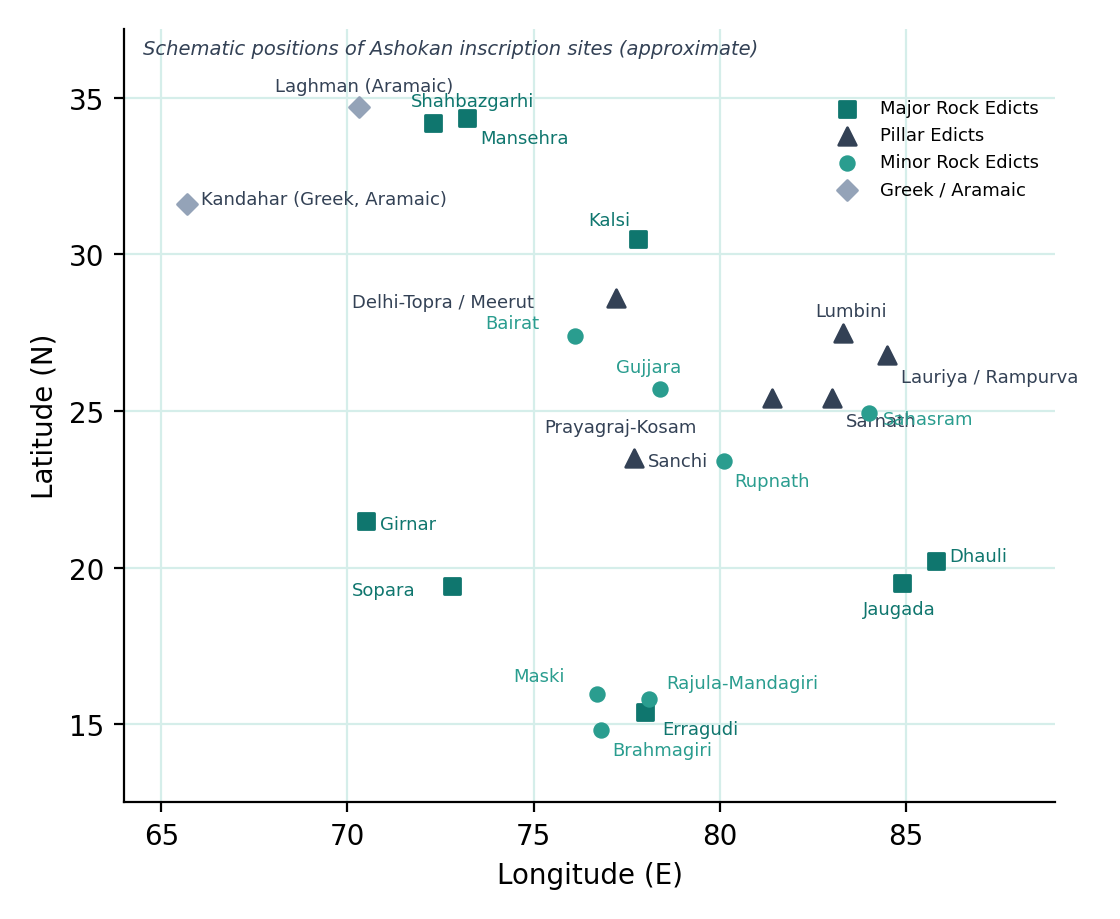
Ashoka's edicts are the earliest deciphered royal inscriptions of India. They are written in Prakrit, mostly in Brahmi; those of the north-west are in Kharosthi, and some at Kandahar are in Greek and Aramaic. James Prinsep deciphered Brahmi in 1837.
Type |
Sites |
Major Rock Edicts (14) |
Shahbazgarhi and Mansehra (Kharosthi), Kalsi (Uttarakhand), Girnar (Gujarat), Sopara (Maharashtra), Erragudi (Kurnool, Andhra), Dhauli and Jaugada (Odisha). At Dhauli and Jaugada, Edicts XI to XIII are left out and two Separate Kalinga Edicts are added |
Minor Rock Edicts |
Maski, Brahmagiri, Siddapura, Jatinga-Rameshwara, Nittur, Udegolam (Karnataka), Rajula-Mandagiri and Erragudi (Kurnool, Andhra), Rupnath, Gujjara, Sahasram, Bairat (Rajasthan) |
Pillar Edicts (7) |
Delhi-Topra, Delhi-Meerut, Lauriya-Araraj, Lauriya-Nandangarh, Rampurva and Prayagraj-Kosam. Delhi-Topra and Delhi-Meerut were later moved to Delhi by Firoz Shah Tughlaq; Delhi-Topra carries all seven edicts |
Minor Pillar Edicts |
Sarnath (Schism Edict), Sanchi, Kaushambi and the Queen's Edict; Rummindei (Lumbini) and Nigali Sagar in Nepal record his visits |
Cave inscriptions |
Barabar and Nagarjuni hills: caves given to the Ajivikas |
The 14 Major Rock Edicts in brief
Edict |
Subject |
I |
Ban on animal sacrifice and festive gatherings (samaja) |
II |
Medical care for humans and animals; names the Chola, Pandya, Satiyaputra, Keralaputra and Tamraparni (Sri Lanka) kingdoms |
III |
Officials to tour every five years |
IV |
Results of Dhamma; Dhamma over war drums |
V |
Dhamma-mahamattas appointed (13th year) |
VI |
Prompt attention to public business; Prativedakas (reporters) |
VII and XII |
Tolerance towards all sects |
VIII |
Dhamma yatras; visit to Bodh Gaya (Sambodhi) |
IX, X, XI |
Dhamma ceremonies, true glory and Dhamma gifts |
XIII |
Kalinga war and Dhamma-vijaya; Greek kings; the Andhras and Pulindas |
XIV |
Summary; the edicts are engraved in different lengths |
7.6 Mauryan Administration
The state (Saptanga)
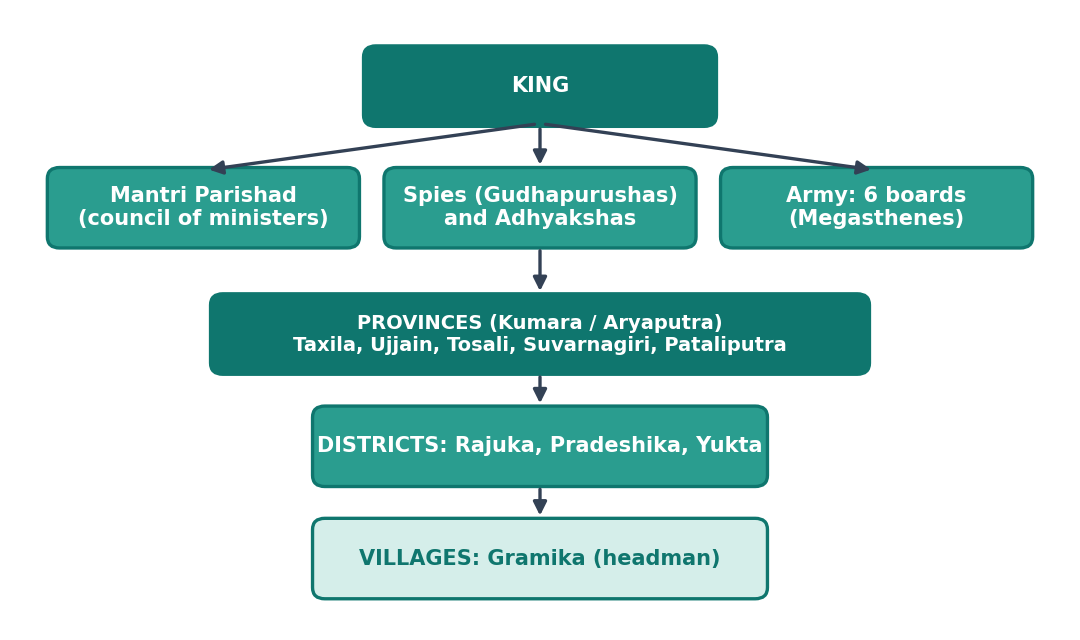
Kautilya describes seven parts of the state: Swami (king), Amatya (ministers), Janapada (territory), Durga (fort), Kosha (treasury), Danda (army) and Mitra (ally).
Level |
Details |
Centre |
King, helped by the Mantri Parishad; Mahamatras; high officials called Tirthas (18 in the Arthashastra); Samaharta (chief of revenue) and Sannidhata (treasurer); heads of departments called Adhyakshas |
Espionage |
A spy network (gudhapurushas), wandering (sanchari) and stationary (sansthana) |
Provinces |
Run by royal princes (Kumara or Aryaputra): Uttarapatha (Taxila), Avantiratha (Ujjain), Prachyapatha (Tosali), Dakshinapatha (Suvarnagiri) and the core region (Pataliputra) |
District |
Rajukas (also judges), Pradeshikas and Yuktas |
Village |
Gramika (headman); the Gopa kept accounts of groups of villages |
City (Megasthenes) |
A board of 30 members in six committees (industry, foreigners, births and deaths, trade, manufactured goods, sale tax of one-tenth) |
Army (Megasthenes) |
Six boards of five members (infantry, cavalry, elephants, chariots, navy, transport); Pliny gives 600,000 infantry, 30,000 cavalry and 9,000 elephants |
Economy
Land revenue (bhaga) was generally one-sixth to one-fourth of the produce; other taxes included bali, pindakara, sulka (tolls) and pranaya (emergency tax). Sita was crown land.
Agriculture was the base; the state supervised irrigation; the Sudarshana lake at Girnar was built.
Trade routes: the Uttarapatha (Taxila to Pataliputra) and the Dakshinapatha; ports such as Tamralipti and Bharuch.
Currency: silver punch-marked coins (pana), also copper coins; the state controlled mines, salt and weaving.
Pataliputra (Palibothra) had a wooden palisade with 64 gates and 570 towers, with a wide moat; the palace was admired by the Greeks.
Society
Megasthenes described seven castes (philosophers, farmers, herdsmen, artisans, soldiers, overseers and councillors), which is not accurate for the Brahmanical four varnas.
He wrote that there was no slavery in India; the Arthashastra shows slaves (dasas) existed, but they had some legal protection.
Women served as spies and bodyguards.
7.7 Mauryan Art and Architecture
Type |
Examples and Features |
Pillars |
Monolithic, polished sandstone (from Chunar), 30 to 40 feet; shaft, lotus capital, abacus and animal (lion, bull, elephant, horse). Sarnath Lion Capital: four lions with the Dharmachakra on the abacus; it is the national emblem (adopted 1950) |
Stupas |
Sanchi (the original brick stupa is Ashokan; enlarged later); tradition says Ashoka built 84,000 stupas |
Rock-cut caves |
Barabar and Nagarjuni hills (Bihar): polished interiors; the Lomas Rishi cave has a wooden-style front; given to the Ajivikas by Ashoka and Dasharatha |
Sculpture |
Didarganj Yakshi (polished sandstone; Patna), Parkham Yaksha (Mathura), Dhauli elephant (Odisha) |
Popular art |
Terracotta figurines and NBPW pottery |
Palace |
Kumrahar (80 pillars) at Pataliputra |
Remember
|
7.8 Decline of the Mauryas
Cause |
Explanation |
Weak successors |
After Ashoka came Dasharatha, Samprati, Shalishuka and others, and finally Brihadratha |
Financial strain |
A huge army and bureaucracy, and heavy gifts to the Sangha |
Oppression by officials |
Revolts at Taxila were caused by the harsh officials |
Division of the empire |
Provinces became independent under weak rulers |
Brahmanical reaction (H. P. Shastri) |
A reaction to Ashoka's pro-Buddhist policy; many historians reject this view |
Invasions |
Pressure from the Bactrian Greeks in the north-west |
End |
Pushyamitra Shunga, the commander, killed Brihadratha at an army review about 185 BCE |
Quick Recall
|
Explore structured courses and guidance for your target examination.