
4. Religious Movements
Free Ancient India rapid revision notes for UPSC, APPSC and TGPSC. Original notes are presented below with their tables, images and visual aids preserved.
4. Religious Movements
4.1 Why New Religions Arose in the 6th Century BCE
Rituals and sacrifices of the Later Vedic religion became costly and complex; animal sacrifice harmed farming, because cattle were needed for the plough.
Brahmana dominance and rigid varna rules angered Kshatriyas, and Vaishyas who had grown rich through trade but had a low rank.
Iron tools, agriculture, trade and towns in the middle Ganga plain created new groups and new ideas.
Preachers used the common language (Pali and Prakrit) instead of Sanskrit, and many wandering teachers (shramanas) attracted followers.
Heterodox sects
Sect / Teacher |
Key Ideas |
Ajivikas (Makkhali Gosala) |
Niyati (fate): everything is predetermined and human effort cannot change it; patronised by Bindusara and Ashoka, who gave them the Barabar caves |
Charvakas / Lokayata (Brihaspati) |
Materialism: only the visible world exists; rejected the soul, rebirth and rituals |
Purana Kassapa |
Akriyavada: actions have no moral result |
Ajita Kesakambali |
Materialist: the body ends with death |
Pakudha Kaccayana |
Everything is made of seven eternal elements |
Sanjaya Belatthiputta |
Scepticism: refused to give a definite answer to questions |
Mahavira and the Buddha |
The two most successful teachers; founded Jainism and Buddhism |
4.2 Jainism
Jainism has 24 Tirthankaras ("ford-makers"). The first was Rishabhanatha (Adinatha), symbol the bull. The 23rd, Parshvanatha, was a prince of Varanasi who taught four vows (Chaturyama). The 24th, Mahavira, is the real founder of the faith as it is known.
Life of Mahavira
Event |
Details |
Birth |
About 540 BCE at Kundagrama near Vaishali (Bihar); Vardhamana; father Siddhartha of the Jnatrika clan; mother Trishala, a Licchavi princess |
Family |
Wife Yashoda; daughter Priyadarshana |
Renunciation |
Left home at 30 and did penance for 12 years |
Enlightenment |
Kevala Jnana (omniscience) at Jrimbhikagrama on the Rijupalika river, under a sal tree; he became Jina (conqueror) and Mahavira (great hero) |
Death |
At Pavapuri near Rajgir at about 72, around 468 BCE |
Disciples |
Gandharas led by Sudharma |
Teachings
Five Mahavratas (great vows): Ahimsa (non-violence), Satya (truth), Asteya (no stealing), Aparigraha (no possessions) and Brahmacharya (celibacy). Brahmacharya was added by Mahavira to Parshvanatha's four vows.
Triratna: right faith, right knowledge and right conduct.
Karma and rebirth; moksha is release from the cycle by removing karma. No creator god; Jiva (soul) and Ajiva (matter).
Anekantavada (many-sidedness of truth) and Syadvada (the doctrine of "may be").
Strict asceticism and extreme non-violence; farmers found it hard to follow.
Councils and sects
Item |
Details |
First Council |
At Pataliputra (about 300 BCE) under Sthulabhadra; compiled the 12 Angas |
Second Council |
At Vallabhi (Gujarat, about 512 CE) under Devardhi Kshamashramana; fixed the final canon |
Digambara |
"Sky-clad" (naked monks); followed Bhadrabahu, who moved south to Karnataka with Chandragupta Maurya (traditionally to Shravanabelagola) |
Svetambara |
"White-clad" monks; followed Sthulabhadra in the north |
Language and texts |
Ardhamagadhi Prakrit; Agamas; the Kalpasutra is by Bhadrabahu |
Patrons and sites
Patrons: Chandragupta Maurya, Kharavela of Kalinga, the Gangas, Rashtrakutas, Chalukyas and Kadambas.
Shravanabelagola (Karnataka): the Gommateshwara (Bahubali) statue was built under the Ganga minister Chavundaraya (981 CE).
Dilwara temples (Mount Abu), Khajuraho Jain temples and the Udayagiri-Khandagiri caves (Odisha).
4.3 Buddhism
Life of Gautama Buddha
Event |
Details |
Birth |
About 563 BCE at Lumbini (Nepal) in the Shakya clan; father Suddhodana, mother Mayadevi; raised by Mahaprajapati Gautami. (Some modern scholars suggest later dates.) |
Family |
Wife Yashodhara; son Rahula |
Four sights |
An old man, a sick man, a dead body and an ascetic |
Great Renunciation (Mahabhinish-kramana) |
Left home at 29 with his charioteer Channa and horse Kanthaka |
Enlightenment (Nirvana) |
At 35 at Bodh Gaya (Uruvela), under a pipal tree on the Niranjana (Phalgu) river |
First sermon (Dharmachakra Pravartana) |
At Sarnath (Isipatana) to five disciples |
Death (Mahaparinirvana) |
At Kushinagara at 80, about 483 BCE |
Great events and places |
Lumbini (birth), Bodh Gaya (enlightenment), Sarnath (first sermon), Kushinagar (death) |
Teachings
Four Noble Truths (Arya Satya): life is suffering (dukkha); suffering has a cause (trishna, craving); suffering can end (nirodha); the path to its end.
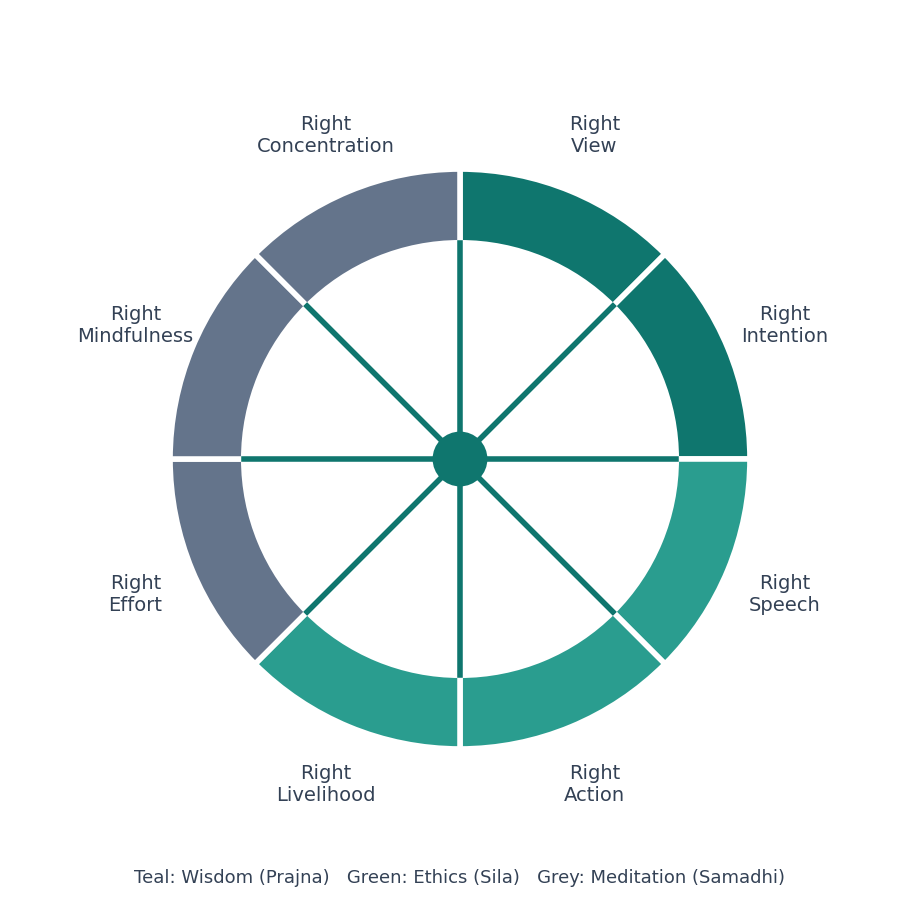
Eightfold Path (Ashtangika Marga): the middle path (Madhyama Pratipada) between luxury and extreme self-denial.
Five precepts (Panchasila): no killing, stealing, lying, intoxicants or sexual misconduct.
Anicca (impermanence), Anatta (no permanent soul), karma and rebirth; the goal is Nirvana.
Triratna: Buddha, Dharma and Sangha.
Rejected Vedic authority, rituals and caste; stressed ethical living.
Sangha
Order of monks (Bhikkhus) and nuns (Bhikkhunis); lay followers were Upasakas and Upasikas.
Mahaprajapati Gautami was the first woman to join; Ananda pleaded for women's entry.
Language: Pali. Chief disciples: Ananda, Sariputta, Moggallana, Upali and Mahakassapa.
Royal patrons: Bimbisara, Ajatashatru, Prasenajit, later Ashoka, Kanishka and Harsha.
Buddhist councils
Council |
Place |
Patron / President |
Outcome |
First (483 BCE) |
Raja-griha |
Ajatashatru / Mahakassapa |
Vinaya Pitaka (Upali) and Sutta Pitaka (Ananda) compiled |
Second (about 383 BCE) |
Vaishali |
Kalashoka / Sabakami |
Split into Sthaviravadins and Mahasanghikas |
Third (about 250 BCE) |
Patali-putra |
Ashoka / Moggaliputta Tissa |
Abhidhamma Pitaka compiled; missionaries sent abroad |
Fourth (about 72 CE) |
Kundal-vana (Kashmir) |
Kanishka / Vasumitra (Ashvaghosha vice-president) |
Split into Hinayana and Mahayana; Sanskrit used |
Sects of Buddhism
Sect |
Key Points |
Hinayana (Theravada) |
Original, strict teaching; Buddha as a teacher; Pali; salvation through own effort; spread to Sri Lanka and Southeast Asia |
Mahayana |
Buddha as a god; idol worship; ideal of the Bodhisattva; Sanskrit; spread to China, Korea and Japan. Philosopher: Nagarjuna (Madhyamika, Shunyavada) |
Vajrayana |
Tantric practices; rituals and mantras; strong in Tibet (Padmasambhava), Bengal and Bihar |
Yogachara |
Philosophy of Asanga and Vasubandhu |
Logic |
Dignaga and Dharmakirti |
Remember
|
Art and architecture
Stupas: dome-shaped mounds with relics: Sanchi (UNESCO site, 1989), Bharhut, Sarnath, Amaravati.
Chaityas (prayer halls) and Viharas (monasteries) cut in rock at Karle, Bhaja, Ajanta, Ellora and Nasik.
Early Buddhism showed the Buddha through symbols: wheel, footprints, empty throne and Bodhi tree; images began with Mahayana.
Decline in India
Revival of Brahmanism and the Bhakti movement; Shankaracharya revived Vedanta.
Corruption in monasteries and the rise of Vajrayana rituals, which lost the original simplicity.
Loss of royal support; invasions of the Huns and later the Turks, who destroyed Nalanda (about 1200 CE).
4.4 Jainism and Buddhism Compared
Feature |
Jainism |
Buddhism |
Founder |
Mahavira (24th Tirthankara) |
Gautama Buddha |
God |
No creator god |
Silent on a creator god; no soul |
Soul |
Every being has a soul (Jiva) |
Anatta: no permanent soul |
Path |
Triratna and strict asceticism |
Eightfold Path, middle way |
Ahimsa |
Extreme; includes all living things |
Moderate; stresses compassion |
Language |
Ardhamagadhi Prakrit |
Pali |
Spread |
Mostly in India (west and south) |
India and across Asia |
Sects |
Digambara and Svetambara |
Hinayana, Mahayana and Vajrayana |
4.5 Buddhist Sites of Andhra Pradesh
Site |
District |
Key Points |
Amaravati (Dhanyakataka) |
Palnadu |
Mahachaitya (great stupa) with fine marble carvings; major Satavahana-period centre |
Nagarjunakonda (Vijayapuri) |
Palnadu |
Ikshvaku capital; Buddhist monasteries and stupas; many sites moved to an island after the Nagarjuna Sagar dam |
Bhattiprolu |
Bapatla |
Among the earliest stupas in Andhra; relic caskets with Brahmi inscriptions |
Jaggayyapeta |
NTR |
Stupa with inscriptions and sculpture |
Salihundam |
Srika-kulam |
Important Buddhist complex including Hinayana and Vajrayana remains |
Thotlakonda and Bavikonda |
Visakha-patnam |
Hill-top Buddhist monasteries and stupas near the coast |
Quick Recall
|
Explore structured courses and guidance for your target examination.