
6. Rise of Magadha
Free Ancient India rapid revision notes for UPSC, APPSC and TGPSC. Original notes are presented below with their tables, images and visual aids preserved.
6. Rise of Magadha
6.1 Why Magadha Became Powerful
Geography: it lay in the fertile middle Ganga plain, between the Ganga, Son and Champa rivers, which gave rich crops and easy river transport.
Iron: nearby iron ore mines (in present Jharkhand) gave strong weapons and farm tools.
Elephants were available from the eastern forests; they formed a powerful part of the army.
Strategic capitals: Rajagriha was ringed by hills; Pataliputra stood at the meeting of the Ganga, Son and Gandak, controlling trade and defence.
Strong and ambitious rulers and a society less bound by Vedic orthodoxy (it was regarded as "impure" in the Vedic texts) that freely supported new ideas.
Trade and taxes from river routes and the new towns provided money for large armies.
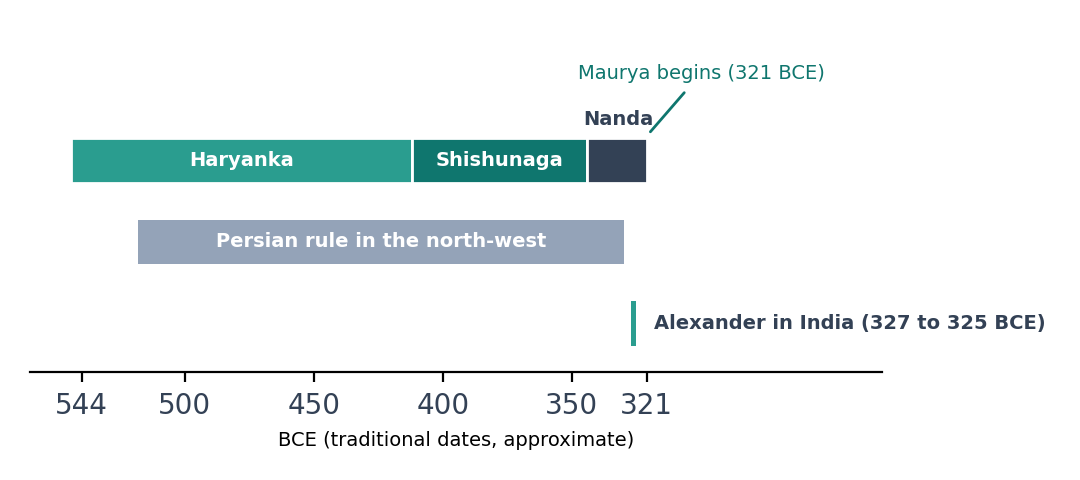
The dates shown are the traditional ones; sources differ by a few years.
6.2 Haryanka Dynasty (about 544 to 412 BCE)
Ruler |
Key Points |
Bimbisara (also Shrenika; about 544 to 492 BCE) |
Founder of the dynasty and a contemporary of the Buddha and Mahavira; capital Rajagriha (Girivraja). Conquered Anga and defeated its king Brahmadatta |
Marriage alliances |
Kosaladevi, sister of Prasenajit of Kosala (brought Kashi as dowry); Chellana, a Licchavi princess of Vaishali; Khema, a princess of Madra (Punjab) |
Other contacts |
Sent the physician Jivaka to the king of Avanti, Pradyota; exchanged envoys with Pukkusati of Gandhara |
Ajatashatru (also Kunika; about 492 to 460 BCE) |
Killed his father Bimbisara. Fought Kosala (Prasenajit) and Kashi; defeated the Vajji confederacy (Licchavis of Vaishali) after a long war using the Rathamusala (a chariot with blades) and Mahashilakantaka (a catapult for stones). Fortified Pataligrama |
Under Ajatashatru |
The First Buddhist Council was held at Rajagriha (483 BCE); the Buddha died in his reign |
Udayin (about 460 to 444 BCE) |
Shifted the capital to Pataliputra (at the confluence of the Ganga and Son) |
Last rulers |
Anuruddha, Munda and Nagadasaka; each murdered his father. The people deposed Nagadasaka, and a minister, Shishunaga, became king |
6.3 Shishunaga Dynasty (about 412 to 344 BCE)
Shishunaga defeated Avanti (the successors of Pradyota) and annexed Avanti and Vatsa, which ended the long Magadha-Avanti rivalry. His capital was at Girivraja first, later also Vaishali.
Kalashoka (Kakavarna) held the Second Buddhist Council at Vaishali (about 383 BCE); he was murdered, and Pataliputra remained the main capital.
The dynasty was ended by the Nandas.
6.4 Nanda Dynasty (about 344 to 321 BCE)
Point |
Details |
Mahapadma Nanda |
Founder; called Ekarat ("sole ruler") and Sarvakshatrantaka ("destroyer of all Kshatriyas"); sometimes called the "second Parashurama" |
Origin |
Of low birth (as per the Puranas, the son of a Shudra woman) and the first non-Kshatriya dynasty of Magadha |
Conquests |
Annexed Kalinga, Panchala, Kuru, Kashi, Surasena, Asmaka and others; the Hathigumpha inscription of Kharavela mentions a Nanda king who took a Jina image from Kalinga and built a canal |
Army |
Greek writers speak of about 200,000 infantry, 20,000 cavalry, 2,000 chariots and 3,000 to 4,000 elephants; the fear of this army is said to have made Alexander's soldiers refuse to advance east of the Beas |
Dhana Nanda |
The last Nanda (Agrammes or Xandrames in Greek accounts); very rich, but unpopular because of heavy taxation |
End |
Overthrown by Chandragupta Maurya with the help of Chanakya (Kautilya) about 321 BCE |
Other |
Patronised Jainism; the Jain minister Shakatala and Sthulabhadra are associated with them |
Remember
|
6.5 Persian (Achaemenid) Invasion
Point |
Details |
Cyrus the Great (558 to 530 BCE) |
Reached the north-west frontier of India (the Kamboja and Gandhara region) |
Darius I (522 to 486 BCE) |
Conquered Gandhara and the Indus valley (Hindush) about 518 BCE; the Behistun inscription (about 520 BCE) names Gandhara and later inscriptions at Persepolis and Naqsh-i-Rustam name Hindush |
Indian satrapy |
The 20th satrapy, the richest of all; Herodotus says it paid 360 talents of gold dust a year |
Xerxes |
Indian soldiers served in his army in Greece, and also fought for Darius III against Alexander at Gaugamela (331 BCE) |
Scylax of Caryanda |
Greek sailor sent by Darius to explore the Indus to the sea |
Effects of Persian contact
Kharosthi script, derived from Aramaic, came into use in the north-west.
Trade between India and Persia grew; coins such as the daric were known.
The Persian influence is seen in Mauryan art: polished stone pillars with bell-shaped capitals, and Ashoka's edicts in a style like Persian royal inscriptions (the word dipi for writing has a Persian origin).
The title satrap later became kshatrapa (used by the Shakas).
The Persian rule ended with Alexander's defeat of Darius III.
6.6 Alexander's Invasion (327 to 325 BCE)
Event |
Details |
Background |
Alexander of Macedon, son of Philip II, defeated Darius III at Gaugamela (331 BCE), then crossed the Hindu Kush into India in 327 BCE. The north-west was divided into small, quarrelling states |
Taxila |
Its ruler Ambhi (Omphis) submitted and helped him |
Battle of the Hydaspes (Jhelum), 326 BCE |
Porus (Paurava) fought bravely but was defeated; Alexander restored his kingdom because he admired him |
Cities founded |
Nicaea (victory) and Bucephala (after his horse Bucephalus) |
Retreat |
At the Beas (Hyphasis) his tired soldiers refused to go further; he turned back |
Return |
Sailed down the Indus with a fleet under Nearchus, and marched back through the Makran (Gedrosia) desert; died in Babylon in 323 BCE |
Time in India |
About 19 months |
Effects of Alexander's invasion
Opened direct land and sea routes between India and Europe; later Greek settlements remained in the north-west.
Destroyed many small states in the north-west, which helped Chandragupta Maurya unify the region.
Cultural contact started the later Gandhara art (Greek and Indian).
Greek accounts (Arrian, Plutarch, Curtius, Justin, Diodorus) are important sources; they give firm dates for Indian history.
It had no lasting political impact; Alexander's officers soon lost control after his death.
Quick Recall
|
Explore structured courses and guidance for your target examination.