
3. Vedic Age
Free Ancient India rapid revision notes for UPSC, APPSC and TGPSC. Original notes are presented below with their tables, images and visual aids preserved.
3. Vedic Age
3.1 The Aryans and the Vedic Period
The Vedic Age is named after the Vedas, the oldest literature of India. It is divided into the Early (Rig) Vedic period and the Later Vedic period. The people who composed the Vedas called themselves Aryas and spoke an Indo-European language (Vedic Sanskrit).
Theories on the original home of the Aryans
Theory / Scholar |
Home suggested |
Max Muller |
Central Asia |
B. G. Tilak |
Arctic region (book: *The Arctic Home in the Vedas*) |
Gordon Childe and Nehring |
Southern Russian steppes |
Dayananda Saraswati |
Tibet |
A. C. Das |
Sapta Sindhu (India itself) |
P. Giles |
Hungary / Danube valley |
Remember
|
3.2 Vedic Literature
Vedic texts are called Shruti ("that which is heard") because they were passed on orally. Later works such as the epics and Puranas are Smriti ("that which is remembered").
Veda |
Key Points |
Rig Veda |
Oldest; 1,028 hymns in 10 Mandalas. Mandalas II to VII are the oldest "family books"; I and X are later. Gayatri Mantra (Mandala III, to Savitri, by Vishwamitra); Purusha Sukta (Mandala X, origin of the four varnas); Nasadiya Sukta (creation) |
Sama Veda |
Hymns set to music (melodies); the basis of Indian music |
Yajur Veda |
Rules and formulas for sacrifice; Shukla (White) and Krishna (Black) Yajur Veda |
Atharva Veda |
Charms, magic and medicine; shows beliefs of ordinary people |
Text |
Key Points |
Brahmanas |
Explain rituals. Aitareya (Rig), Shatapatha (Yajur), Panchavimsha (Sama), Gopatha (Atharva) |
Aranyakas |
"Forest texts" for hermits; a link between rituals and philosophy |
Upanishads |
Philosophy of Atman (soul) and Brahman (universal soul), karma, rebirth and moksha |
Vedangas |
Six limbs: Shiksha (phonetics), Kalpa (rituals), Vyakarana (grammar), Nirukta (etymology), Chhanda (metre) and Jyotisha (astronomy) |
Upavedas |
Ayurveda (Rig), Dhanurveda (Yajur), Gandharvaveda (Sama), Shilpaveda (Atharva) |
Famous lines from the Upanishads
|
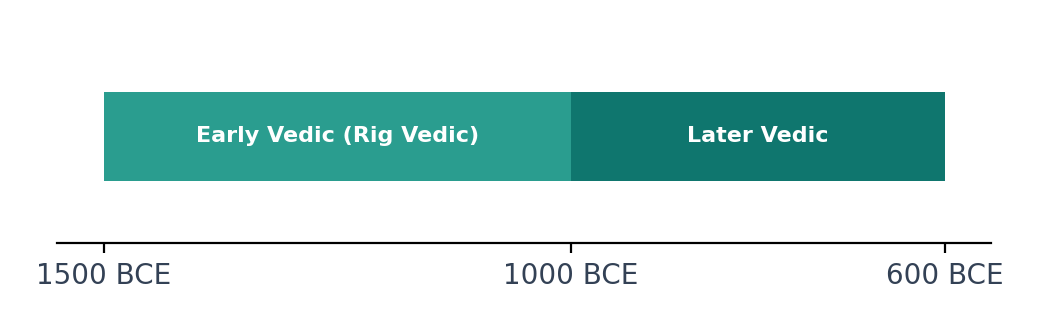
3.3 Early Vedic (Rig Vedic) Period, about 1500 to 1000 BCE
Geography
The Aryans lived in Sapta Sindhu, the land of seven rivers: the Indus and its five Punjab tributaries, with the Sarasvati. The Sarasvati was the greatest river ("Nadi-tama"). The Ganga is mentioned only once and the Yamuna a few times.
Rig Vedic name |
Modern name |
Sindhu |
Indus |
Vitasta |
Jhelum |
Asikni |
Chenab |
Parushni (Iravati) |
Ravi |
Vipasa |
Beas |
Shutudri |
Sutlej |
Kubha |
Kabul |
Gomati |
Gomal |
Krumu |
Kurram |
Suvastu |
Swat |
Polity
Feature |
Details |
Form of state |
Tribal monarchy; the Rajan (king) was a war leader, helped by the tribal assemblies; kingship was mostly hereditary |
Social-political units |
Kula (family) → Grama (village) → Vish (clan) → Jana (tribe) |
Assemblies |
Sabha (council of elders), Samiti (assembly of the whole tribe) and Vidatha (the oldest; religious, social and military matters). Women also took part in the Vidatha |
Officials |
Purohita (chief priest), Senani (army chief), Gramani (village head), Vrajapati (pasture officer), Spasha (spy) |
Revenue |
No regular taxes; voluntary gifts called Bali; no standing army |
Battle of Ten Kings (Dasarajna) |
On the Parushni (Ravi); Sudas of the Bharata clan (priest Vasishtha) defeated a union of ten tribes; the Purus were among those defeated |
Economy and society
Economy was mainly pastoral; cattle were the main wealth (words such as Gavishti, search for cows, meant battle; Godhuli was a time of day).
Agriculture was secondary; barley (yava) was the main crop. Iron was unknown; Ayas meant copper or bronze.
Barter was the main trade; Nishka was a gold ornament; Panis were traders.
Society was tribal and patriarchal; varna (colour) divided Aryans and Dasas; the Purusha Sukta (a late hymn) mentions four varnas, which were not yet hereditary.
Women had a respected position: they attended assemblies and some, such as Lopamudra, Ghosha, Apala and Vishwavara, composed hymns.
Religion
Deity |
Role |
Indra |
Most important; god of war and rain; Purandara (destroyer of forts); about 250 hymns |
Agni |
Fire god and messenger between gods and humans; about 200 hymns |
Varuna |
Guardian of Rita, the cosmic order |
Soma |
God of the Soma plant; all of Mandala IX |
Surya, Savitri, Ushas, Pushan, Vayu, Maruts, Ashvins, Aditi |
Other nature gods and goddesses |
Worship |
Nature worship through simple sacrifices (yajna); no temples or idols; prayers for cattle, sons and victory |
3.4 Later Vedic Period, about 1000 to 600 BCE
Geography and polity
The Aryans moved east into the Ganga-Yamuna doab, then to Kosala, Kashi and Videha. The centre was Kuru-Panchala. The Kurus were formed when the Bharatas and Purus merged.
Region of Aryavarta was described as the area between the Himalayas and the Vindhyas.
Small tribal kingdoms grew into larger janapadas (territorial states). The king was stronger, and the idea of territory (rashtra) grew.
The Sabha and Samiti lost importance; the Vidatha disappeared.
Kings performed Ashvamedha (horse sacrifice for supremacy), Rajasuya (coronation) and Vajapeya (chariot race), to show power.
Officials: Bhagadugha (collector of the royal share), Sangrahitri (treasurer), Akshavapa (accountant), Suta (charioteer), Gramani.
Revenue: the Bali became a regular tax, and the king had a share (Bhaga) of the produce.
Economy
Agriculture became the main occupation; wheat, rice (vrihi), barley, pulses and sesame; the plough and manure were used.
Iron appears: Krishna Ayas or Shyama Ayas; iron tools at Atranjikhera and other PGW sites helped forest clearing.
Crafts included metal working, pottery, weaving and carpentry; trade grew, with the first signs of coins, such as Nishka, Satamana and Krishnala.
Society
The four varnas became hereditary; Brahmanas and Kshatriyas were dominant; Shudras were at the bottom.
Gotra (a group claiming descent from a common sage) appeared; marriage within the gotra was forbidden.
The four ashramas: Brahmacharya, Grihastha, Vanaprastha and Sannyasa; the Jabala Upanishad mentions all four.
The position of women declined (child marriage began, and they were kept away from assemblies), though learned women like Gargi and Maitreyi appear in the Brihadaranyaka Upanishad.
Religion and philosophy
Prajapati (the creator), Vishnu and Rudra became important; Indra and Agni declined; Pushan became the god of the Shudras.
Rituals grew complex and priests (Brahmanas) became powerful.
The Upanishads criticised rituals and stressed knowledge (jnana), the Atman-Brahman link, karma, rebirth and moksha.
Four Purusharthas developed later: Dharma, Artha, Kama and Moksha.
3.5 Early and Later Vedic Compared
Feature |
Early Vedic |
Later Vedic |
Main texts |
Rig Veda |
Sama, Yajur, Atharva Vedas, Brahmanas, Upanishads |
Area |
Punjab and Sapta Sindhu |
Ganga-Yamuna doab and the middle Ganga plain |
Polity |
Tribal chief; strong assemblies |
Territorial kingdom; powerful king; weaker assemblies |
Economy |
Pastoral; barter |
Agriculture; iron; early coins |
Metal |
Copper and bronze (Ayas) |
Iron (Krishna Ayas) |
Society |
Varna based on occupation; fluid |
Hereditary varnas; gotra; ashramas |
Women |
Respected; attended assemblies |
Position declined |
Deities |
Indra, Agni, Varuna |
Prajapati, Vishnu, Rudra |
Worship |
Simple yajna; no temples |
Complex rituals, sacrifices; Upanishadic thought |
Quick Recall
|
Explore structured courses and guidance for your target examination.