
1. Basic Concepts of Economy
Free Economy rapid revision notes for UPSC, APPSC and TGPSC. Original notes are presented below with their tables, images and visual aids preserved.
1. Basic Concepts of Economy
1.1 What is Economics?
Economics studies how a society uses its limited resources to meet unlimited wants. Because resources are scarce, every society must decide what to produce, how to produce and for whom to produce.
Branch |
Focus |
Examples |
Micro- economics |
Decisions of individual units: a household, a firm or a single market |
Price of a commodity, consumer demand, firm output |
Macro- economics |
The economy as a whole |
GDP, inflation, unemployment, fiscal and monetary policy |
1.2 Economic Systems
System |
Key Features |
Capitalism |
Private ownership of resources; prices and profit guide production; minimal state role. Associated with Adam Smith and the classical school. |
Socialism |
The state owns or controls the main resources; aims at equality and welfare. Soviet-style planning is the classic example. |
Mixed economy |
Public and private sectors exist together; the market works but the state regulates and provides public goods. India follows this model. |
Remember
|
1.3 Economic Agents
Economic agents are the units that take economic decisions. There are four main ones:
Households: consume goods and services and supply factors of production.
Firms: produce goods and services using those factors.
Government: collects taxes, spends, regulates and provides public goods.
External sector: the rest of the world, linked through trade and capital flows.
1.4 Sectors of the Economy
Based on the nature of activity
Sector |
What it covers |
Examples |
Primary |
Extracting natural resources and raw produce |
Farming, fishing, mining, forestry |
Secondary |
Turning raw materials into finished goods |
Manufacturing, construction, power |
Tertiary |
Services to people and businesses |
Banking, transport, health, retail |
Quaternary |
Knowledge-based work |
Research, IT, education |
Quinary |
Top-level decision making |
Senior government and corporate leadership |
Based on organisation
Organised (formal) sector: registered with the government and covered by labour laws, such as the Factories Act; workers get regular wages and social security.
Unorganised (informal) sector: small, unregistered units without fixed terms of work or social security, such as street vendors, farm labourers and small shopkeepers.
A large share of India's workforce is in the unorganised sector, while the tertiary sector contributes the largest share of GDP.
1.5 Types of Goods
By use
Type |
Meaning |
Consumer goods |
Bought by final users for direct use, such as clothes and food |
Capital goods |
Durable goods used to produce other goods, such as machines and tools |
Intermediate goods |
Used up as inputs in making other goods, such as rubber for tyres |
Final goods |
Meant for final use and not processed further, such as a finished car |
By demand behaviour
Type |
Meaning |
Normal good |
Demand rises when income rises |
Inferior good |
Demand falls when income rises (coarse grains, for example) |
Luxury good |
Demand rises more than proportionately as income rises |
Substitutes |
Can replace each other: tea and coffee. If one gets costlier, demand for the other rises |
Complements |
Used together: pen and ink. If one gets costlier, demand for the other falls |
Giffen good |
A rare inferior staple whose demand rises as its price rises, because it is a poor household's main food |
Veblen good |
A status good whose demand rises with its price, because a high price signals prestige |
By rivalry and excludability
Type |
Rival? |
Excludable? |
Example |
Private good |
Yes |
Yes |
Bread, a car |
Public good |
No |
No |
National defence, street lights |
Common resource |
Yes |
No |
Fish in open seas, groundwater |
Club good |
No |
Yes |
Cable TV, a toll road |
Merit goods (education, health) give society benefits beyond the buyer's own, so the state encourages or provides them. Demerit goods (alcohol, tobacco) harm society, so they are taxed or restricted.
1.6 Circular Flow of Income
In a simple two-sector economy, households sell factors of production to firms and receive income. They spend that income on the goods and services firms produce. Money flows one way and real resources flow the other, so income, output and expenditure are equal in value.
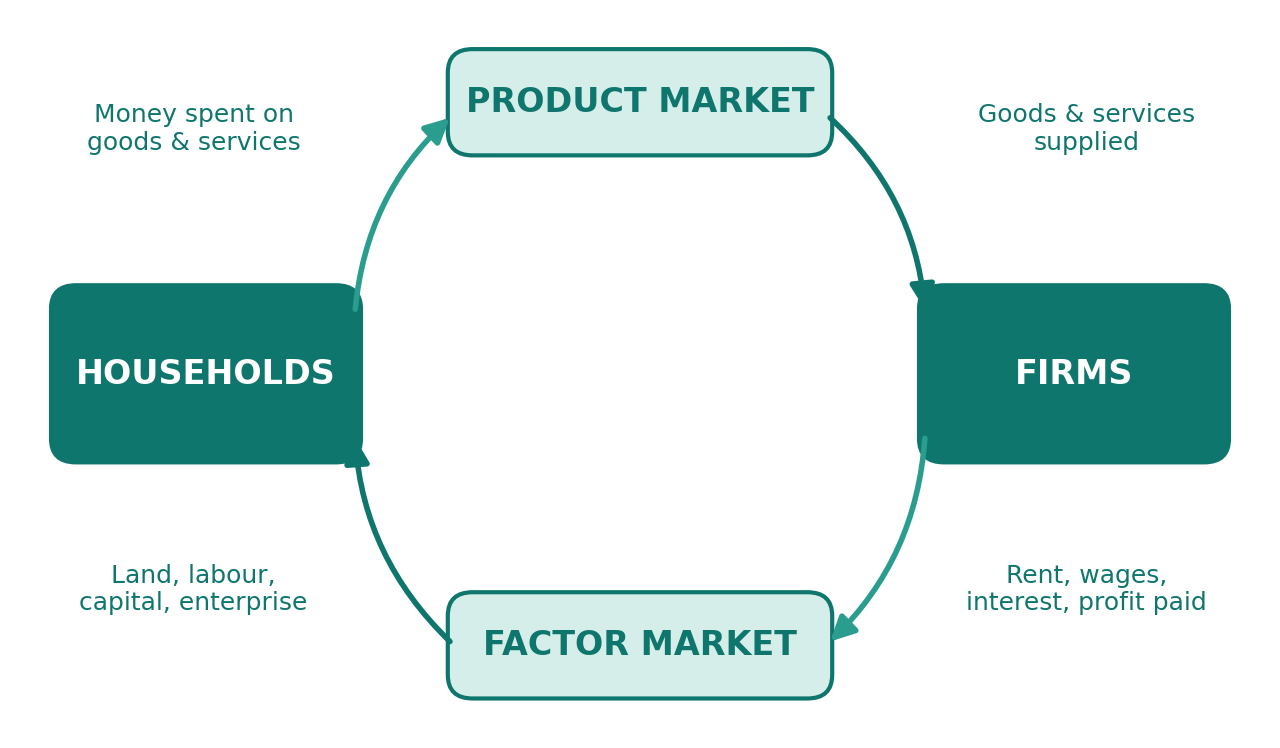
Leakages (savings, taxes, imports) take money out of the flow. Injections (investment, government spending, exports) add money back.
1.7 Measuring Economic Growth
Economic growth is the rise in the real value of goods and services an economy produces over time. Gross investment is spending on capital goods. Net investment = Gross investment − Depreciation, where depreciation is the wear and tear of capital.
Key national income concepts
Concept |
Meaning |
GDP |
Total market value of all final goods and services produced within the country's borders in a year |
GNP |
GDP + Net Factor Income from Abroad (NFIA). It counts income earned by a country's residents anywhere |
NDP |
GDP − Depreciation |
NNP |
GNP − Depreciation |
National Income |
NNP at factor cost, the total income earned by a country's factors of production |
Per capita income |
National income divided by population |
Nominal GDP |
Measured at current prices, so it is affected by inflation |
Real GDP |
Measured at base-year prices, so it shows true output growth |
GDP deflator |
(Nominal GDP ÷ Real GDP) × 100; a broad measure of price change across the economy |
Transfer payments |
One-way payments with no goods or services in return, such as pensions and PM-KISAN. They are not counted in GDP |
Market price and factor cost
Market price (MP): the price actually paid, including indirect taxes and net of subsidies.
Factor cost (FC): what factors of production receive, so it leaves out indirect taxes and adds back subsidies.
GDP at MP = GDP at FC + Indirect taxes − Subsidies
GVA (Gross Value Added) = Value of output − Value of intermediate consumption. In India, GVA at basic prices = GDP at market prices − (Product taxes − Product subsidies).
India's national accounts use the base year 2011-12. They are compiled by the National Statistics Office (NSO) under MoSPI.
1.8 Three Methods of Measuring National Income
Method |
What is added up |
Note |
Production (value added) |
Value added by every sector |
Avoids double counting of intermediate goods |
Income |
Wages, rent, interest and profit |
Sums incomes of all factors |
Expenditure |
C + I + G + (X − M) |
Consumption, investment, government spending and net exports |
1.9 Factors of Production
Factor |
Reward |
Example |
Land |
Rent |
Soil, minerals, water, forests |
Labour |
Wages |
Physical and mental human effort |
Capital |
Interest |
Machinery, buildings, finance |
Entrepreneurship |
Profit |
Organising and risk-taking |
Quick Recall
|
Explore structured courses and guidance for your target examination.